Cecilia Ceccarelli
1. Congratulations on winning in the Global Photography Awards! Can you share a little about yourself, what inspired you to pursue photography, and how has your journey evolved since your first shot?
Ciao! My name is Cecilia Ceccarelli, and I’m from Rome, Italy. I’m currently studying architecture and I’ll soon complete my bachelor’s degree. After that, I’m planning to pursue a master’s degree focused on urban design. Photography has always been the medium that allows me to capture architecture most naturally. I’ve always been fascinated by how a single image can communicate emotions and ideas that can sometimes be difficult to express through words. Over time, my approach has become more conscious: I started simply by taking pictures of what caught my attention, while today I think much more about composition, geometry, light, and the relationship between spaces.
2. Can you share the story or inspiration behind your award-winning piece? How does winning this award make you feel about your journey in photography?
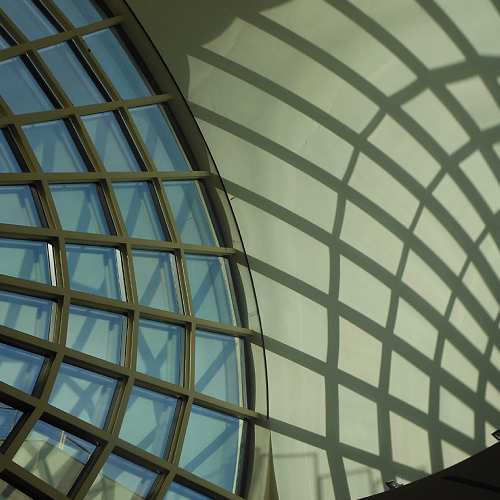
The photograph came from my interest in architecture, geometry, and the way light can completely transform a space. What caught my attention was the relationship between the curved structure and its shadow: they almost mirror each other, creating a second architecture made only of light and darkness. I was especially interested in the contrast between the rigid grid of the structure and the softer, almost abstract shape of the shadow. I honestly wasn’t expecting to win, especially after seeing so many great photographs in the competition, so I was genuinely surprised. The award gave me more confidence in the work I’m creating and made me feel that I should keep developing my photographic language and see how far I can take it.
3. How do you decide which photo to submit for a competition?
I look closely at the composition first: whether the empty and filled spaces feel balanced and whether I’m satisfied with the geometry of the image. Then I consider light and shadow, color, saturation, and the overall atmosphere. In the end, I usually choose the photograph that feels both visually strong and complete.
4. What first made you pick up a camera?
I’ve always enjoyed taking pictures, for as long as I can remember. I almost always had a camera in my hand, whether I was on a school trip or simply taking a walk with my parents. Photography came very naturally to me before I even started thinking of it as something serious.
5. What’s your favorite type of photography, and why do you love it?
I really enjoy photographing things that somehow stand out from their surroundings. If I see, for example, a brightly colored tree against a landscape of concrete, that immediately catches my attention. More generally, I’m drawn to images that document a habit, a way of life, or a particular atmosphere and that can evoke a strong feeling in the viewer. For that reason, I would probably say documentary photography is the genre I feel closest to.
6. What’s your go-to camera setup, and why does it work best for your projects? What’s your favorite feature?
I use a very simple camera, a Nikon Coolpix S6200. It doesn’t offer an overwhelming number of settings, which actually works well for the way I photograph. While shooting, I mainly concentrate on exposure and composition rather than on the technical complexity of the equipment. If necessary, I refine the image later in post-production. In the case of my winning photograph, however, I was very happy with the result straight out of the camera and didn’t need any post-processing. What I like most about it is its simplicity and portability, because I can always have it with me and react quickly when something catches my attention.
7. If someone looked at your work, what’s the one thing you’d want them to feel?
I would like them to feel a sense of visual power and perhaps even a slight sense of intimidation — something that approaches the Kantian idea of the "sublime".
8. What was the most challenging part of capturing your winning shot?
The most challenging part was finding the right exposure. I wanted to preserve the details visible through the glass while also keeping the shadow clearly defined and the architectural structure readable. The contrast between the brighter and darker areas was quite strong, so finding the right balance was the main challenge.
9. Is there a specific place or subject that inspires you the most?
I find ruins particularly interesting. Brutalist architecture and post-industrial spaces also immediately catch my attention. I’m very drawn to places where materials, structures, and traces of time become visually dominant.
10. Who or what has been your biggest influence in photography?
My parents are both passionate about photography, so I grew up surrounded by it. But the person who probably gave me the biggest push was my grandfather. Since I was little, I always saw him carrying a camera with him wherever he went. He is very dedicated to creating photo albums of every trip he took and of the people he loves most. I think that made photography feel like a natural way of preserving experiences and memories.
11. What message would you share to inspire photographers to participate in photography awards, and what advice would you give to help them excel in the competition?
Let people see what your mind is able to see. Focus on one idea or emotion that you genuinely want to communicate, and work on it until the image expresses it clearly. I also believe that one strong photograph is better than five mediocre ones, so be selective and submit the work you truly believe in.
12. What’s one piece of advice for someone just starting in photography?
Look at the work of other artists and study how they build their compositions. Try to understand why an image works rather than simply whether you like it or not. In my opinion, composition is at least 50% of the work!
13. What role do editing and post-processing play in your creative workflow?
They play an important role in my workflow. Sometimes it can be something as simple as cropping, while other images may require more work, such as bringing out textures that are difficult to see in the original shot. For me, post-processing is not about completely transforming an image, but about emphasizing qualities that are already there.
14. How do you see technology, like AI, influencing the future of photography and your own approach?
I believe photography stands on its own, but AI can be useful in certain ways. For example, it can help analyze an image quite objectively, looking at elements such as geometry, composition, or visual balance, and it can help you understand why a photograph may not be working as well as you intended and how you could improve it. At the same time, I think its role has limits: it cannot replace the act of being there, observing something, and deciding to take the photograph yourself in the first place.
15. If you could photograph anything or anyone in the world, what would it be?
I would love to photograph wildlife in the jungle or on the savanna. It would be completely different from the subjects I usually photograph, which is exactly why I think I would find it fascinating — ideally from a safe and respectful distance.